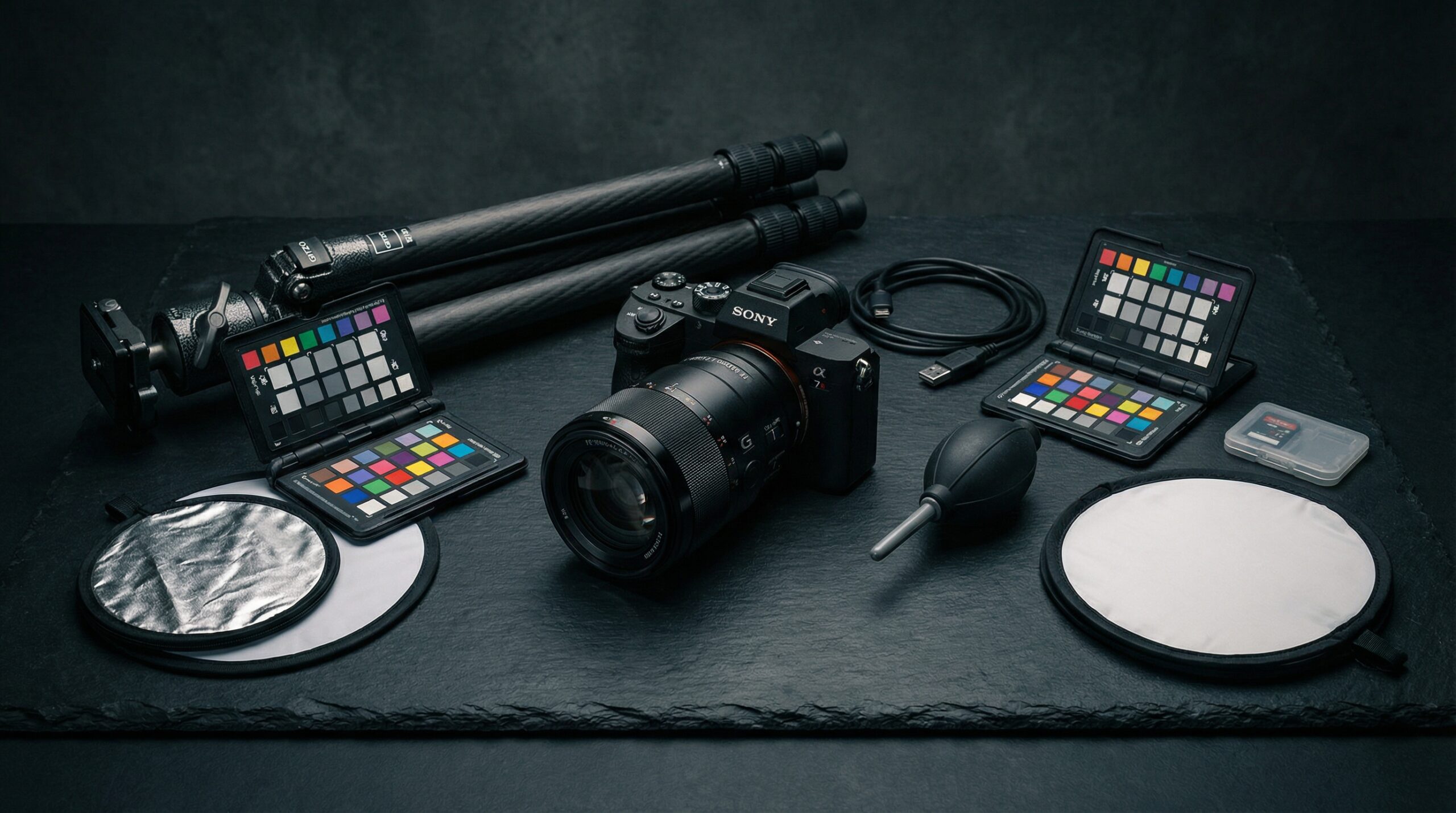

I get asked two questions more than any other in my work: “What camera should I buy?” and “What gear do I actually need for product photography?” The first question is mostly irrelevant to the second. Product photography is not about the camera — it’s about the light, the optics, the stability, and the color accuracy.
You can produce better product photography with a $500 camera and $2,000 of lighting gear than with a $5,000 camera and $200 of lighting gear. This guide is about what actually matters for product photography in 2026.
The Priority Hierarchy: What Actually Moves the Needle
Most photographers have this hierarchy backwards. They spend $3,000 on a camera body and $300 on lighting. Here’s what actually determines product photography quality:
- Lighting: 40% of your final image quality is determined here
- Lenses: 25% — optics matter more than sensor resolution for product work
- Stability: 15% — tripod and camera support affect every image
- Color accuracy: 10% — monitor calibration and color management
- Camera: 10% — important but not the primary quality driver
Lighting: Where to Invest the Most
Strobe Lights for Still Life
For still life and tabletop product photography, strobe lights offer the most flexibility and best value for professional results. The Profoto B10 Plus ($2,099 per head) is the industry standard — exceptional color consistency, powerful output, TTL and HSS capability.
For budget-conscious photographers: the Godox AD600 Pro ($599) delivers approximately 90% of the Profoto B10‘s performance at 30% of the price. The color consistency is slightly less refined, but for product photography in a controlled studio environment, it’s the correct budget recommendation.
Continuous LED for Tabletop and Video
If you’re shooting products that will appear in video content as well as stills, continuous LED panels offer “what you see is what you get” illumination that makes setup faster and more intuitive.
The Godox SL-60 ($120) is the budget entry point for serious continuous product lighting. The Nanlite PavoSlim 60B ($249) is the significant upgrade — CRI 96+, TLCI 97+, and a flat panel form factor uniquely suited to tight tabletop product shooting.
Lenses: The Optics That Actually Matter
The Macro Lens: Non-Negotiable for Small Products
If you shoot products smaller than approximately 30cm in any dimension, you need a macro lens. At 1:1 magnification (life-size on the sensor), the detail capture in product photography is in a different category from standard lenses.
My recommendation: the Sony FE 90mm f/2.8 Macro G OSS ($898). The 90mm focal length gives you comfortable working distance from your subject, the f/2.8 maximum aperture is useful for selective focus work, and the built-in image stabilization is genuinely useful for tabletop work at slow shutter speeds.
Budget alternative: the Tamron SP 90mm f/2.8 Di VC USD ($549). It matches the Sony’s optical quality at a significantly lower price point.
Standard Zoom for Larger Products
For products larger than 30cm — shoes, bags, larger packaged goods — a standard zoom covering approximately 24-70mm gives you more compositional flexibility. The Sony FE 24-70mm f/2.8 GM II ($2,298) is the professional standard. The Sigma 24-70mm f/2.8 DG DN Art ($899) delivers approximately 95% of the GM’s optical quality at 40% of the price.
Stability: Tripods and Camera Support
A good tripod is not exciting. It is essential. Product photography often involves long exposures, precise framing, and consistent shooting across multiple setups. A cheap tripod introduces vibration and drift that will cost you more time than the money you saved.
For studio product photography: the Gitzo GT3543LS ($899) is the professional standard. Carbon fiber, rock-solid stability, and a longevity that makes the price-per-year genuinely economical. A tripod with a horizontally-positionable center column is essential for flat lays and top-down shots.
The Macro Focusing Rail
A focusing rail is a micro-adjustment slider between your tripod and camera, allowing precise forward/back adjustment for critical focus in macro product photography. At 1:1 magnification, autofocus is often unreliable — a focusing rail gives you manual control at a precision that focus rings can’t match.
The Weifeng WF-9008 ($45) is the budget option that works reliably. The Novoflex Castel-Micro ($399) is the professional choice.
Color Accuracy: The Gear Most Photographers Skip
Monitor Calibration
If your monitor isn’t accurately displaying color, you’re making editing decisions based on fiction. The Datacolor Spyder X Pro ($159) is the correct entry point for monitor calibration. For product photography, the Spyder X Elite ($229) adds studio matching that’s worth the $70 premium if you’re running dual monitors.
ColorChecker Passport
A ColorChecker Passport Photo ($95) is a physical reference card with standardized color patches. Photograph it in your lighting setup, then use the included software to create a custom camera profile. This ensures the red in your product photography is the same red as the product’s actual color.
My Product Photography Kit (2026)
| Category | Item | Price | Priority |
|---|---|---|---|
| Lighting | Godox AD600 Pro (2x) | $1,198 | Essential |
| Modifiers | Westcott Rapid Box 90cm softbox (2x) | $180 | Essential |
| Lens | Sony FE 90mm f/2.8 Macro G OSS | $898 | Essential |
| Lens | Sigma 24-70mm f/2.8 DG DN Art | $899 | Important |
| Tripod | Gitzo GT3543LS | $899 | Important |
| Stability | Weifeng WF-9008 focusing rail | $45 | Important |
| Color | Datacolor Spyder X Pro | $159 | Essential |
| Color | ColorChecker Passport Photo | $95 | Important |
Total essential kit: ~$2,500 | Full professional kit: ~$5,500
The Bottom Line
Product photography gear is not about the camera. It’s about light, optics, stability, and color accuracy — in that order. Build your kit accordingly.
If you’re starting with a $500 budget: buy one strobe, one softbox, a $50 reflector, and the Tamron 90mm macro. This $500 kit will teach you more about product photography than a $2,000 camera body ever could. Invest in lighting first. Everything else is supporting infrastructure.

Commercial and editorial still life photographer with 12 years of experience shooting for major brands and publications. Based in New York City, specializing in studio product photography, portrait lighting, and commercial campaigns.