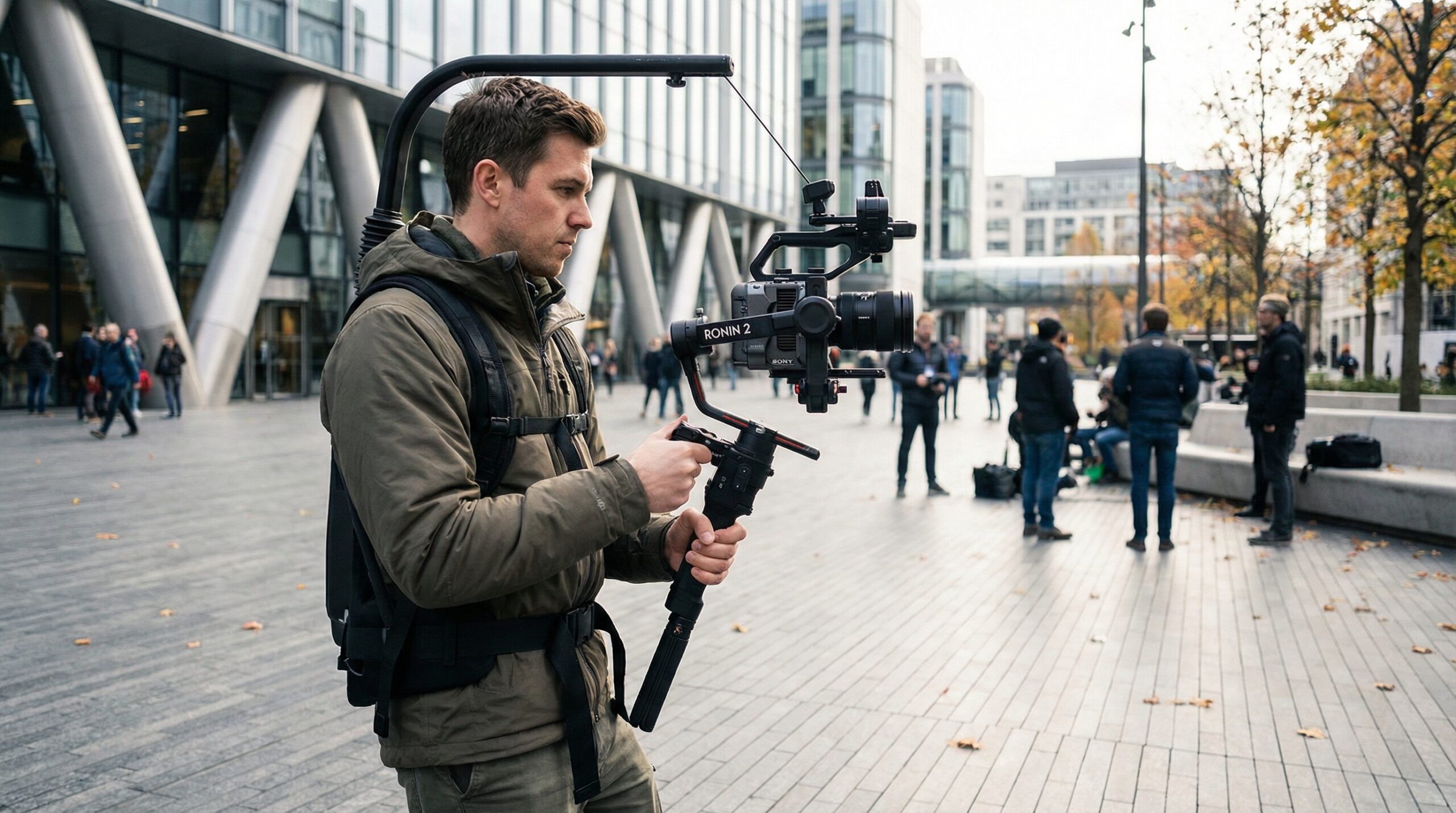

I’ve been shooting with the Sony FX3 for a couple of years now, and if there’s one thing I’ve learned, it’s that the body is only half the story. The FX3 is a beast — full-frame sensor, incredible low-light performance, and a cinema pedigree that punches well above its price point. But hand-hold it for six hours on a run-and-gun shoot, and your arms will remind you exactly why gimbals exist.
Here’s the thing about the FX3 that most gimbal guides miss: the body itself weighs just 630g. That sounds light. But the moment you mount a decent lens — say a Tamron 28-75mm or a Sigma 35mm — you’re looking at 1.2–1.8kg. Add a follow focus, a SmallRig cage, an external mic, or an ND filter? You’re pushing 2.5kg without breaking a sweat. And that’s exactly where gimbal payload specs go from marketing numbers to actual dealbreakers.
I’ve run five gimbals through the FX3 paces over the past several months — real shoots, real conditions. Documentary work, wedding cinematography, narrative shorts, travel content. This isn’t a spec-sheet comparison. This is field experience from someone who depends on this gear to make a living.
Why Payload Capacity Is Everything for FX3 Users
Let me be direct: don’t run a Sony FX3 rig on any gimbal rated under 3kg. Yes, the FX3 body is light. But gimbal specs always rate at optimal balance — meaning a 3kg-rated gimbal is not your friend at 2.8kg. Motors work harder, battery drains faster, and stabilization gets sloppy. Give yourself at least 1kg of headroom above your actual rig weight.
For most FX3 setups:
- Minimal rig (body + prime lens): ~1.2–1.4kg
- Standard rig (body + zoom + cage + mic): ~1.8–2.2kg
- Full rig (body + heavy zoom + cage + monitor + mic): ~2.5–3kg+
Keep that in mind as we go through each option.
The Contenders: Five Gimbals Tested with the Sony FX3
1. DJI RS4 Pro — ~$649 | The Clear Winner
If you’re serious about the FX3 and you want one gimbal that handles everything without complaint, the DJI RS4 Pro is the answer. Full stop.
DJI rated it at 4.5kg payload, which means it handles even an aggressive FX3 build with room to spare. The motors are noticeably more powerful than its predecessor — I felt it immediately when I put a Tamron 28-200mm on the FX3 for a documentary shoot. No hunting, no drift, no stuttering on fast pans. The RS4 Pro just… holds.
What makes it genuinely great for the FX3 specifically is the Sony camera control integration. Through USB-C, you get native focus control, start/stop recording, and ISO/aperture adjustment right from the gimbal’s joystick and wheel. On a run-and-gun shoot where both hands are occupied, this is a massive operational upgrade. You’re not fumbling for the camera body to hit record — you just roll.
Battery life is rated at 13 hours. Real-world with an active rig, I got closer to 9–10 hours, but that’s still a full shoot day. The RS4 Pro also uses DJI’s SuperSmooth algorithm for wide-angle lenses, and the LiDAR focusing accessory (sold separately) opens up genuinely impressive follow-focus capability for solo work.
The price is the one thing that gives people pause. At $649 for the gimbal alone — or closer to $900 with the combo kit — it’s an investment. But if the FX3 is your primary camera, this is the gimbal you buy once and stop thinking about. The RS4 Pro is the professional’s choice because it’s reliable, feature-rich, and built to match the camera it’s holding.
Best for: Professional filmmakers, wedding videographers, documentary shooters, anyone who wants zero compromises.
2. DJI RS4 — ~$429 | Best All-Rounder
The RS4 sits in a fascinating sweet spot. It’s rated for 3kg — enough for most FX3 setups, though you’ll want to stay mindful with heavier builds. The stabilization is excellent, the Sony integration is the same as the Pro (USB-C native control), and it uses DJI’s RSA quick-release plate which makes swapping between rigs genuinely fast.
Where the RS4 trails its bigger sibling: motor torque under load. With a heavier lens or an ND filter that shifts balance, the RS4 works harder. It’s still capable, but you’ll notice it. Battery life is rated at 12 hours, and I consistently got 8–9 hours in the field — comparable to the Pro in real-world use.
The folding design is excellent. It collapses into a compact form that fits in a camera bag without drama — something the heavier Pro doesn’t quite match. For travel shoots and mixed-use work where the FX3 isn’t always running a heavy rig, the RS4 hits the right balance of performance and portability.
The DJI Mimo app integration is polished. Timelapse, motion blur mode, panorama — all accessible and actually useful. DJI’s ecosystem is mature in a way that competitors are still catching up to.
Best for: Hybrid shooters, content creators, photographers stepping into video, anyone wanting a capable all-arounder without the Pro price tag.
3. Zhiyun Crane 4 — ~$399 | The Feature-Rich Alternative
Zhiyun has been making gimbals almost as long as DJI, and the Crane 4 shows they’re not just along for the ride. Rated at 3kg payload, it directly competes with the RS4 on paper. In practice, the Crane 4 brings a few genuinely differentiated features that matter to FX3 users.
The built-in pull-out mini screen on the Crane 4 (on the combo version) is legitimately useful — you can see settings, battery level, and mode info without pulling out your phone. The TransMount Mini 2.0 quick release is one of the fastest on the market; I’ve tested it repeatedly and it’s noticeably snappier than DJI’s RSA system.
Zhiyun’s VCAM app (formerly ZY Play) has improved significantly. Sony camera control works through USB, though it’s not quite as seamless as DJI’s implementation — a few features require more app navigation. The follow modes (PF, PT, F, L, POV) are all present and responsive.
My main critique of the Crane 4: build quality feels slightly less premium than the DJI options. The axis locks work fine but feel a bit plasticky compared to DJI’s more refined construction. Battery life is rated at 12 hours — similar to the RS4 in actual use.
At $399, the Crane 4 is a legitimate option if you’re cross-shopping with the RS4 and want to save $30 while getting Zhiyun’s ecosystem of accessories. But if Sony camera control integration is a priority, DJI still has the edge.
Best for: Filmmakers who want deep feature sets at competitive pricing, Zhiyun ecosystem users, those who prioritize quick release speed.
4. Zhiyun Weebill S — ~$259 | The Budget Pick
Let me be honest about the Weebill S: it’s an older gimbal that’s been in Zhiyun’s lineup long enough to come down to a very accessible price. It’s rated at 3kg — impressive for the price point — and if your FX3 rig stays lean (body plus a prime lens), it absolutely gets the job done.
The underslung shooting mode is where the Weebill S earns its reputation. Holding the gimbal below the camera creates a low-angle perspective that’s surprisingly stable and cinematic. For documentary-style walking shots and low-angle coverage, it’s a natural fit.
But the Weebill S shows its age in a few ways. The app is less polished than DJI Mimo. The follow modes work, but feel less refined. Camera control integration for Sony requires a bit more setup. And the battery — rated at 8 hours — drains faster than the newer competition, especially under motor load.
For someone who’s just getting started with gimbal work, or who needs a second gimbal rig without spending serious money, the Weebill S at $259 is a solid entry point. Don’t expect it to keep up with a heavily kitted-out FX3 rig, but for a camera body and a single lens? It works.
Best for: Budget-conscious shooters, beginners, backup gimbal setups, minimal FX3 rigs with prime lenses.
5. Moza AirCross 3 — ~$329 | The Sleeper Pick
The Moza AirCross 3 doesn’t get as much attention as the DJI and Zhiyun options, and I think that’s partly a marketing gap rather than a performance gap. At 3.2kg payload capacity, it comfortably sits above the Weebill S and competes directly with the Crane 4 and RS4.
What I genuinely appreciate about the AirCross 3 is the form factor. It’s lighter than the DJI RS4 — 950g versus 1.3kg for the RS4. On a long shoot day, that 350g difference is real. The AirCross 3 is also notably compact in its folded configuration, which makes it my actual travel pick (more on that in the recommendations).
Stabilization quality is good — not DJI-Pro-level great, but genuinely solid. The Inception mode (spinning 360° roll) is smooth and consistent. Battery life sits at around 11–12 hours rated, and I got 8–9 hours in the field.
The MOZA Master app works, though it’s the roughest of the bunch UI-wise. Sony camera integration is present but limited compared to DJI’s native implementation. The quick release system is competent but not exceptional.
At $329, the AirCross 3 represents genuine value if weight and portability are your primary constraints. For international travel shoots where every gram matters, it’s worth serious consideration.
Best for: Travel filmmakers, weight-conscious shooters, those running lighter FX3 setups, budget-to-mid shooters who want slightly better specs than Weebill S.
Watch Before You Buy: Real-World Gimbal Footage
Before dropping money on any of these, watch how they actually perform in the field. Here are two videos worth your time:
Head-to-Head Comparison
| Gimbal | Payload | Battery Life | Price | Best For |
|---|---|---|---|---|
| DJI RS4 Pro | 4.5kg | ~13 hrs | ~$649 | Pro filmmakers, heavy rigs |
| DJI RS4 | 3kg | ~12 hrs | ~$429 | All-rounders, hybrid shooters |
| Zhiyun Crane 4 | 3kg | ~12 hrs | ~$399 | Feature seekers, Zhiyun users |
| Moza AirCross 3 | 3.2kg | ~11 hrs | ~$329 | Travel, lightweight setups |
| Zhiyun Weebill S | 3kg | ~8 hrs | ~$259 | Budget, minimal rigs |
Key Features That Matter for FX3 Users
Follow Modes
All five gimbals offer standard follow modes: pan-follow, pan-tilt-follow, full lock, and full follow (POV). The quality of these modes varies more than specs suggest. DJI’s implementation is the smoothest — transitions between modes are fluid, and the speed/responsiveness tuning in the app is granular and intuitive. Zhiyun is close. Moza is adequate.
For the FX3’s cinema roots, you’ll likely spend most time in pan-follow mode — tilt locked, pan follows. It’s the workhorse mode for walking shots and interviews. All five gimbals do this competently.
Balancing & Setup Time
All gimbals require balancing when you change lenses. This is non-negotiable — a poorly balanced gimbal is an unhappy gimbal. The DJI RS4 Pro has the most intuitive balance adjustment system, with a tool-free pan axis lock that makes front-to-back balance easy. The Crane 4 is close. The Weebill S requires a bit more patience.
DJI’s AutoTune feature (on RS4/RS4 Pro) automatically calibrates motor strength after balancing — a smart feature that removes guesswork.
My Recommendations: By Use Case
🏆 Overall Winner: DJI RS4 Pro
If your FX3 is your primary camera and you’re working professional shoots, spend the $649 on the RS4 Pro. The extra payload headroom (4.5kg vs 3kg), superior Sony integration, and build quality justify the premium. You’ll stop thinking about the gimbal and start thinking about the shot — which is exactly what a tool should do.
💰 Budget Pick: Zhiyun Weebill S
If you’re working with a minimal FX3 setup — body, prime lens, maybe a small mic — and $649 is genuinely out of reach, the Weebill S at $259 gets you into the game. Just know its limitations: keep your rig light, manage battery expectations, and don’t push it with heavy zooms or cage setups.
✈️ Travel Pick: Moza AirCross 3
For international travel shoots where airline baggage weight matters, the AirCross 3’s lighter body (950g vs RS4’s 1.3kg) and compact folded size make a real difference. You get solid 3.2kg payload, respectable battery life, and a gimbal that won’t dominate your carry-on. Pair it with a prime lens on the FX3 and you have a travel-friendly cinema rig.
Best Mid-Range: DJI RS4
For most shooters reading this — hybrid filmmakers, content creators, wedding videographers — the RS4 at $429 is the pragmatic choice. You get DJI’s ecosystem, native Sony control, solid 3kg payload, and a mature, well-supported product. The step up to the RS4 Pro only makes sense if you’re regularly running heavy rigs or need the absolute best motor performance.
Final Thoughts
The Sony FX3 is a remarkable camera precisely because it’s adaptable — it can be a lightweight run-and-gun machine or a fully-kitted cinema camera depending on what you put around it. Your gimbal choice should match how you actually shoot, not how you imagine you’ll shoot.
If I had to give a single recommendation to an FX3 owner walking into a camera store today: get the DJI RS4 if you’re on a reasonable budget, and upgrade to the RS4 Pro when your shoots demand it. Both will serve the FX3 well, integrate cleanly with Sony’s system, and hold up to the kind of real-world abuse that professional filmmaking involves.
The gimbals I haven’t mentioned — the budget no-name options on Amazon — are a false economy. A dropped camera because a cheap gimbal motor gave out costs more than the price difference. Trust the brands that have been in this space long enough to get the engineering right.
Shoot more. Stabilize better. The FX3 deserves a gimbal that keeps up with it.
Quick Release Systems
This is underrated. When you’re switching between handheld and gimbal multiple times per day, the quick release system is something you interact with constantly. DJI’s RSA system is excellent — secure, fast, and compatible across DJI gimbals and cages. Zhiyun’s TransMount Mini 2.0 is arguably faster. Moza’s system works but feels less refined.
If you’re building a modular rig around the FX3 — cage, top handle, gimbal switching — DJI’s ecosystem of compatible plates gives you the most options.
App Control & Native Camera Integration
For the FX3, native camera control via USB is a significant operational advantage. With the DJI RS4 or RS4 Pro connected via USB-C to the FX3, you can:
- Start/stop recording from the gimbal joystick
- Adjust ISO and aperture
- Control focus (with compatible lenses)
- Trigger shutter for photo mode
This alone can change your shooting workflow significantly. Solo documentary shooters especially — having camera control at your fingertips without reaching for the body is a genuine game-changer.
Zhiyun and Moza offer camera control too, but the implementation is less seamless. It works — it’s just not as deeply integrated into the physical controls.
Balancing & Setup Time
All gimbals require balancing when you change lenses. This is non-negotiable — a poorly balanced gimbal is an unhappy gimbal. The DJI RS4 Pro has the most intuitive balance adjustment system, with a tool-free pan axis lock that makes front-to-back balance easy. The Crane 4 is close. The Weebill S requires a bit more patience.
DJI’s AutoTune feature (on RS4/RS4 Pro) automatically calibrates motor strength after balancing — a smart feature that removes guesswork.
My Recommendations: By Use Case
🏆 Overall Winner: DJI RS4 Pro
If your FX3 is your primary camera and you’re working professional shoots, spend the $649 on the RS4 Pro. The extra payload headroom (4.5kg vs 3kg), superior Sony integration, and build quality justify the premium. You’ll stop thinking about the gimbal and start thinking about the shot — which is exactly what a tool should do.
💰 Budget Pick: Zhiyun Weebill S
If you’re working with a minimal FX3 setup — body, prime lens, maybe a small mic — and $649 is genuinely out of reach, the Weebill S at $259 gets you into the game. Just know its limitations: keep your rig light, manage battery expectations, and don’t push it with heavy zooms or cage setups.
✈️ Travel Pick: Moza AirCross 3
For international travel shoots where airline baggage weight matters, the AirCross 3’s lighter body (950g vs RS4’s 1.3kg) and compact folded size make a real difference. You get solid 3.2kg payload, respectable battery life, and a gimbal that won’t dominate your carry-on. Pair it with a prime lens on the FX3 and you have a travel-friendly cinema rig.
Best Mid-Range: DJI RS4
For most shooters reading this — hybrid filmmakers, content creators, wedding videographers — the RS4 at $429 is the pragmatic choice. You get DJI’s ecosystem, native Sony control, solid 3kg payload, and a mature, well-supported product. The step up to the RS4 Pro only makes sense if you’re regularly running heavy rigs or need the absolute best motor performance.
Final Thoughts
The Sony FX3 is a remarkable camera precisely because it’s adaptable — it can be a lightweight run-and-gun machine or a fully-kitted cinema camera depending on what you put around it. Your gimbal choice should match how you actually shoot, not how you imagine you’ll shoot.
If I had to give a single recommendation to an FX3 owner walking into a camera store today: get the DJI RS4 if you’re on a reasonable budget, and upgrade to the RS4 Pro when your shoots demand it. Both will serve the FX3 well, integrate cleanly with Sony’s system, and hold up to the kind of real-world abuse that professional filmmaking involves.
The gimbals I haven’t mentioned — the budget no-name options on Amazon — are a false economy. A dropped camera because a cheap gimbal motor gave out costs more than the price difference. Trust the brands that have been in this space long enough to get the engineering right.
Shoot more. Stabilize better. The FX3 deserves a gimbal that keeps up with it.

Mehedi Rahman is a freelance multimedia producer and impact filmmaker with 12+ years of experience. He has shot documentary and humanitarian work across Yemen, Bangladesh, and South Asia for the World Food Programme and international media. Based in Sri Lanka, he specialises in visual storytelling that moves people — and gear that makes it possible.
One response to “Best Gimbals for the Sony FX3 in 2026: Full-Frame Tested”
Had the DJI RS3 Pro for eight months now and the motor strength improvement over the RS2 is real. The automatic axis lock on startup saves probably 3-4 minutes per shoot in setup time.