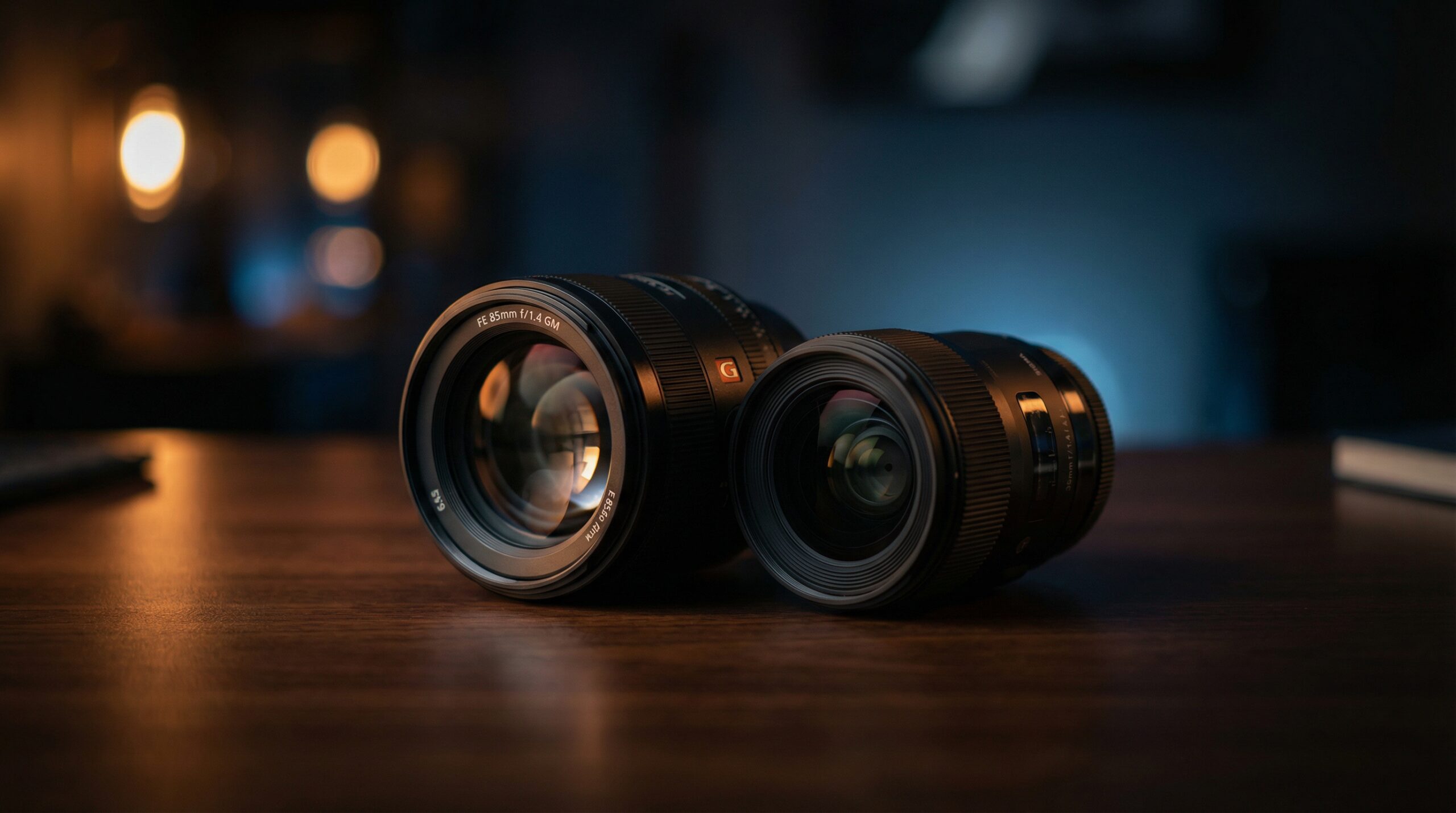

There’s a look that lives rent-free in every filmmaker’s head. Those horizontal lens flares stretching across the frame. The oval bokeh that makes city lights look like floating pills of color. The subtle vignetting that draws your eye to center. It’s the anamorphic look — and until recently, getting it required lenses that cost more than a used car.
Then Sirui released their 1.33x anamorphic line, starting at around $400 per lens. I bought the 50mm, mounted it on my Sony FX30, and shot a 7-minute narrative short film over a weekend. Budget: $800 total (lens + one day of location permits + food for two actors I found on Instagram). Here’s everything I learned.
Why Anamorphic on a Budget Is Now Possible
Traditional anamorphic cinema lenses — Cooke, Panavision, ARRI — cost $10,000 to $50,000 per lens. Even the “affordable” Atlas Orion set runs $18,000 for a set of three. That pricing locks out 99% of independent filmmakers.
Sirui changed the game by using a modest 1.33x squeeze factor (instead of the traditional 2x), which means:
- Fewer optical compromises at consumer price points
- Works with standard camera sensors (no need for an anamorphic desqueeze adapter)
- Most NLEs handle the desqueeze natively
- You still get the flares, the bokeh, and the wider field of view
Tito Ferradans, who’s probably the internet’s foremost anamorphic specialist, gave the most honest take I’ve heard:
“Is the Sirui as good as a Cooke? Of course not. But the Cooke costs 40 times more. The Sirui gives you 70% of the anamorphic magic for 2% of the price. For indie filmmakers, that math is a no-brainer.”
— Tito Ferradans, Anamorphic Lens Specialist (YouTube)
The Shoot: What I Planned
I wrote a simple script — two characters, one location (a dimly-lit café that a friend owns), dialogue-driven with a climactic reveal shot. I wanted to test whether the Sirui 50mm could deliver a genuinely cinematic look, or whether the “budget anamorphic” label meant “budget results.”
My kit for the shoot:
| Gear | Cost | Role |
|---|---|---|
| Sony FX30 | Owned | Camera body (APS-C sensor maximizes the anamorphic effect) |
| Sirui 50mm T2.9 1.33x | $400 | Primary lens |
| SmallRig Cage + Handle | Owned | Rigging |
| 2x Godox SL60W | Owned ($130/ea) | Key + fill light |
| Location permit | $200 | Café rental (4 hours) |
| Food for actors | $200 | Pizza + coffee (the true currency of indie film) |
| Total | $800 |
What Worked Beautifully
The flares. Oh my god, the flares. Point the Sirui toward any light source — practicals in the background, a candle, the café’s neon sign — and you get these gorgeous horizontal streaks that look like they belong in a Ridley Scott film. They’re not the sharp, electric-blue Cooke flares, but they’re warm, golden, and organic. My actors noticed them on the monitor and started improvising around the lighting, angling themselves to catch flares in the background.
The bokeh. At T2.9, the oval bokeh is unmistakable. City lights through the café window turned into elongated ovals that screamed “cinema.” This is the single biggest visual differentiator from spherical lenses, and the Sirui delivers it convincingly.
The wider field of view. A 50mm with a 1.33x squeeze gives you the field of view of roughly a 37mm lens, but with the compression and subject isolation of a 50mm. It’s a strange, beautiful combination that feels different from any spherical lens I’ve used.
What Was Challenging
Focus breathing. The Sirui exhibits noticeable focus breathing — the image slightly shifts in framing as you pull focus. For static shots this doesn’t matter, but for rack-focus pulls between two actors, it’s visible. I worked around it by cutting between close-ups instead of racking focus within a shot.
Minimum focus distance. At 0.85m (~2.8 feet), you can’t get extremely tight close-ups. For the dialogue scenes, I was always at least three feet from my actors, which meant framing was “medium close-up” at tightest.
Post-production desqueeze. You need to apply a 1.33x horizontal stretch in your NLE. DaVinci Resolve and Final Cut handle this natively. Premiere requires a manual transform. Not hard, but it’s an extra step that slows down editing if you forget.
The Verdict: Was It Worth It?
Absolutely. The Sirui 50mm anamorphic gave my $800 short film a look that people genuinely couldn’t believe came from a sub-$500 lens. When I showed the footage to a DP friend who shoots on Cookes, his exact words were: “That’s not fair. That should not look this good for the price.”
Is it technically perfect? No. Is it characterful, cinematic, and emotionally engaging? Yes. And in filmmaking, character beats perfection every time.
As Niko from Corridor Crew put it after their own budget anamorphic test:
“When your audience feels something watching your film, they’re not thinking about lens resolving power or chromatic aberration. They’re thinking about the story. Anamorphic makes them feel the story harder.”
— Niko Pueringer, Corridor Crew
Disclosure: This article contains affiliate links. As an Amazon Associate, Film Gear Review earns from qualifying purchases. Our editorial opinions are always our own.


As an Amazon Associate we earn from qualifying purchases.

Mehedi Rahman is a freelance multimedia producer and impact filmmaker with 12+ years of experience. He has shot documentary and humanitarian work across Yemen, Bangladesh, and South Asia for the World Food Programme and international media. Based in Sri Lanka, he specialises in visual storytelling that moves people — and gear that makes it possible.
2 responses to “I Shot a Short Film on Anamorphic for $800 — Here’s What I Learned”
The flares look absolutely gorgeous! It’s insane how much character these Sirui lenses add to the image for under $500.
Did you find the 1.33x squeeze factor noticeable enough? I’ve been holding out for a 1.6x but the price of the 50mm is so tempting.