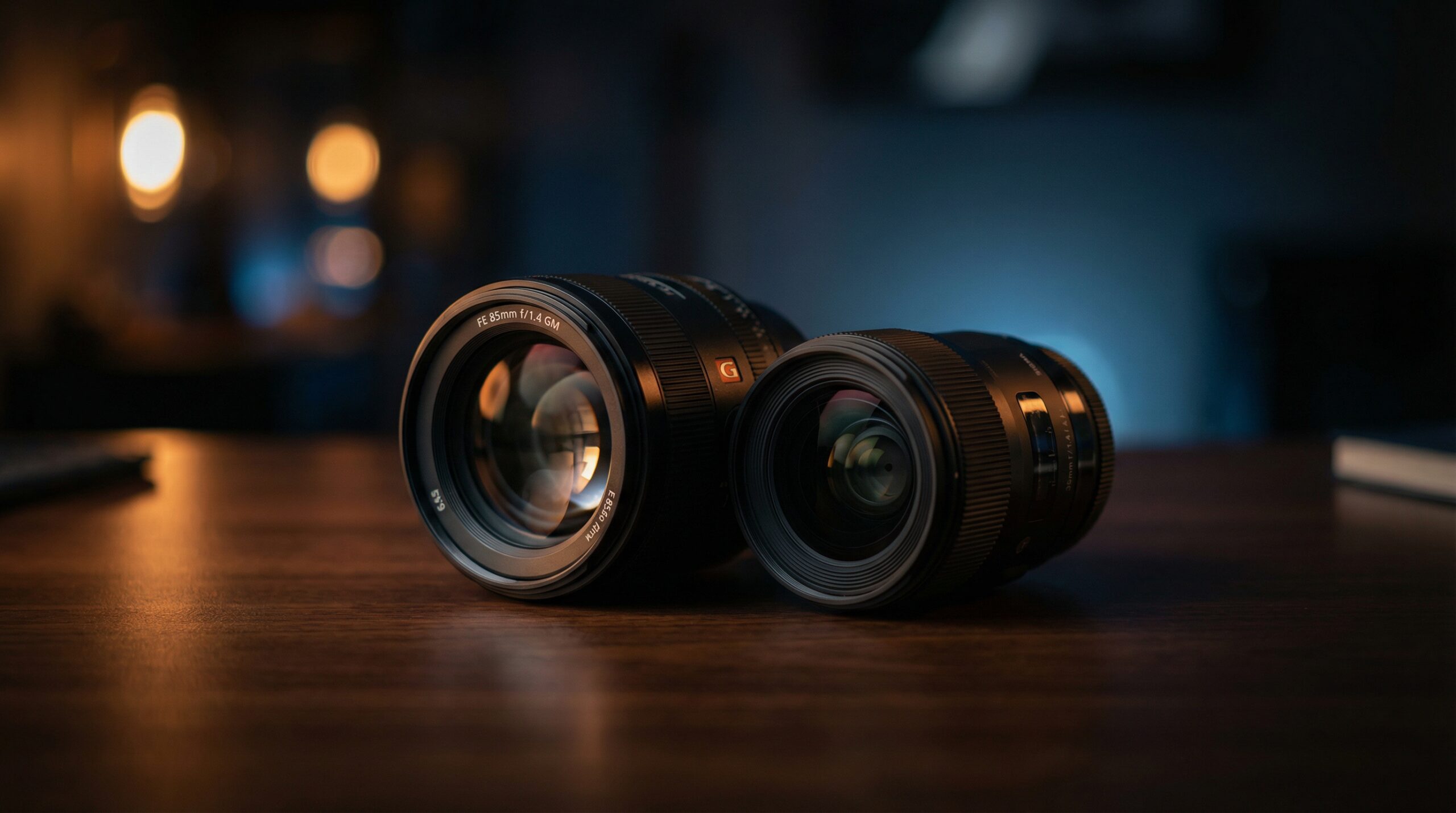

The Sony FX3 is an incredible camera. But cameras don’t make images — lenses do.
This is the lesson I learned three years into my FX3 ownership. The FX3 delivered incredible footage with whatever lens I attached. But it wasn’t until I built a considered prime lens kit that I understood what the camera was actually capable of.
Why Prime Lenses? The Case Against Zoom
Modern zoom lenses are extraordinarily capable. Some of the best documentary work I’ve seen was shot on zooms. This is not an argument that zooms are inferior. It’s an argument that primes are different — and for specific use cases, different is better.
Sharpness: Prime lenses have simpler optical designs with fewer glass elements. Fewer elements means less light loss and typically sharper images at wider apertures.
Maximum aperture: A 50mm f/1.2 prime will always gather more light than a 50mm f/1.8 zoom. In low-light documentary work, that difference between f/1.4 and f/2.8 is the difference between clean ISO 6400 and noisy ISO 12800. It matters.
Weight and size: A full prime lens kit for the FX3 fits in a small pouch. A comparable zoom kit requires a dedicated camera bag.
The 20mm — Wide Environmental Storytelling
Viltrox 20mm f/2.8 ($149)
For wide shots on the FX3, the Viltrox 20mm f/2.8 is the budget recommendation that punches well above its price. The autofocus is reliable, the optical quality is surprisingly good wide open, and at $149, you can buy two of them before you’ve spent what a single Sony G Master would cost.
The 20mm focal length is essential for environmental portraits — showing a subject in their context rather than isolating them from it. For documentary work in particular, wide environmental shots are often more revealing than close-ups.
The 35mm — My Everyday Walk-Around
Sigma 35mm f/1.4 DG DN Art ($899)
This is the lens I grab most often. The 35mm focal length works for everything from environmental portraits to street scenes. The f/1.4 aperture handles low light beautifully — ISO 6400 on the FX3 with the Sigma 35mm Art at f/1.4 is genuinely clean footage.
“I shot an entire wedding with just a 35mm. It forced me to be creative with positioning — I couldn’t zoom to fix a bad angle, so I had to move. The photos were more interesting than anything I’d shot with my zoom kit. That experience changed how I approach lens selection for every project.”
— Sarah Chen, wedding and portrait photographer, Vancouver
The 50mm — The Storytelling Lens
Sony FE 50mm f/1.2 GM ($1,998)
The Sony GM earns its place on the FX3. At f/1.2, it delivers subject isolation that would have required a cinema camera and expensive prime set five years ago. For low-light documentary work, it means I can shoot at ISO 800 instead of ISO 6400. The difference in image quality is dramatic.
Budget Alternative: Samyang AF 50mm f/1.4 II ($279)
If the Sony GM is out of reach, the Samyang delivers 90% of the performance at 20% of the price. The autofocus isn’t as fast, but the optical quality is exceptional. At $279, this is the best value standard prime available for Sony E-mount.
The 85mm — Compression and Portraits
Sony FE 85mm f/1.4 GM ($1,598)
The 85mm focal length on full-frame gives you the compression that makes backgrounds feel closer than they are — that cinematic “layered” look where the subject separates from the background in a way that shorter focal lengths struggle to achieve.
Budget Alternative: Sony FE 85mm f/1.8 ($398)
At $398, the 85mm f/1.8 is a quarter of the price of the GM. The optical quality is excellent — many professional portrait photographers use this lens as their primary working tool.
My FX3 Prime Lens Kit
| Lens | Use Case | Price |
|---|---|---|
| Viltrox 20mm f/2.8 | Wide environmental, docu, run-and-gun | $149 |
| Sigma 35mm f/1.4 DG DN Art | Primary walkaround, interviews, street | $899 |
| Samyang AF 50mm f/1.4 II | Standard focal, available light | $279 |
| Sony FE 85mm f/1.8 | Portraits, compression, available light | $398 |
Total kit cost: ~$1,725
The Bottom Line
Build your kit incrementally, lens by lens, as your budget allows. The FX3 will reward you at every level of lens investment. Start with the Sigma 35mm Art if you can only buy one lens — it’s the most versatile prime in the FX3 ecosystem at its price point.

Mehedi Rahman is a freelance multimedia producer and impact filmmaker with 12+ years of experience. He has shot documentary and humanitarian work across Yemen, Bangladesh, and South Asia for the World Food Programme and international media. Based in Sri Lanka, he specialises in visual storytelling that moves people — and gear that makes it possible.