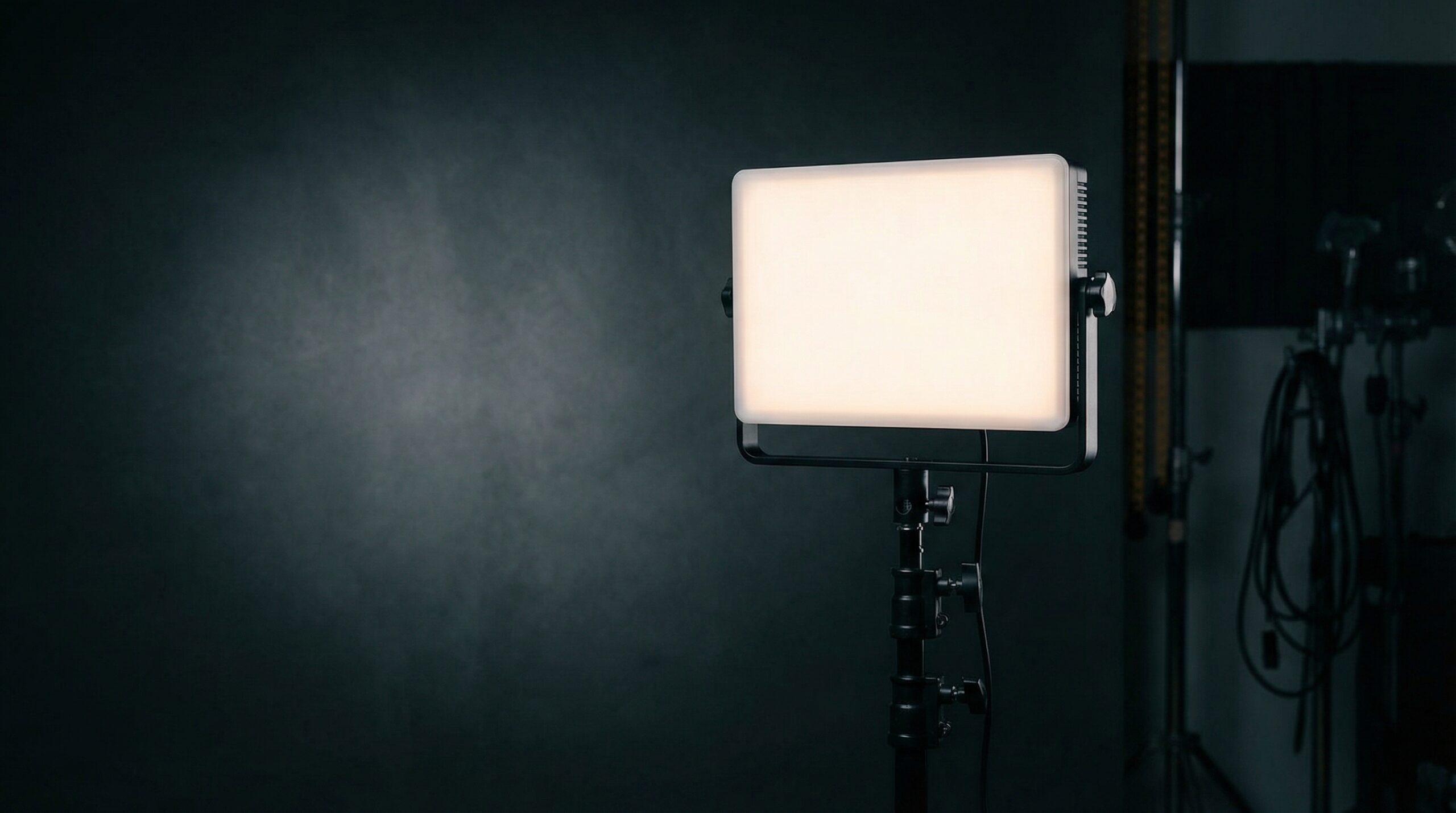

Let me tell you about the shoot that changed how I think about budget LED lights. I was in Cox’s Bazar, shooting in a refugee settlement at night. The only light source was a single overhead fluorescent tube — the kind that makes everyone look jaundiced and dead behind the eyes. I pulled out a $70 LED panel I’d bought off Amazon six months earlier, dialed it to 3200K, and bounced it off a white wall behind me. The resulting footage looked like someone had actually lit the scene. My colleague asked what I’d used. He didn’t believe me when I told him.
Budget LED lights have changed. They are not what they were five years ago. And if you’re a solo filmmaker or photographer who can’t justify a $600 Aputure 60x, here’s what’s actually worth buying in 2026 under $100.
What to Actually Look for in a Budget LED
Before we get to specific recommendations, let’s talk about what separates the usable from the useless in this price range. Three specs matter:
Color temperature range: The minimum acceptable is 3200K to 5600K. Many budget lights only do 5600K daylight — which makes them useless for indoor shooting without CTO gels. Look for a light that covers both tungsten and daylight.
CRI rating: CRI (Color Rendering Index) measures how accurately a light reproduces colors. Anything below 90 CRI will make your subjects look sickly in a way that post-production can’t fully fix. Many budget manufacturers inflate CRI claims — treat anything above 95 with skepticism.
Power output: Measured in watts or lux at 1 meter. For a 3200K LED panel under $100, you want something that can compete with ambient indoor light. Anything below the equivalent of a 60W incandescent bulb is going to struggle in real shooting conditions.
Best Overall: Lume Cube LC-ADB1
At $79, the Lume Cube is the most versatile budget LED on the market. 5600K daylight-balanced, 3200K tungsten with the included diffuser, CRI rating of 95+, and a magnetic mounting system that makes it genuinely useful for run-and-gun video work.
What makes it the standout: the magnetic mount lets you attach it to any metal surface immediately. No stands, no straps, no tape. You can stick it to a filing cabinet, a door frame, a car hood — anywhere there’s metal — and you’ve got a practical light source in thirty seconds.
The LC-ADB1 also works as a strobe for stills photography, which is a genuinely useful dual-purpose feature for hybrid shooters. It’s not the most powerful light here, but it’s the most flexible.
“I bought three Lume Cubes for a location documentary in Morocco. I was shooting in riads with terrible natural light and virtually no electrical access. Those three little panels, running off USB battery packs, gave me enough light to make the footage look intentional rather than salvageable. I still travel with them.”
— Priya Sharma, documentary photographer and filmmaker, Mumbai
Best for Video: Neewer 660 LED
At $89, the Neewer 660 is a substantial upgrade in power and control. 660 individual LEDs (hence the name), adjustable from 3200K to 5600K, CRI 95+, and a rear panel with individual knobs for color temperature and brightness. Unlike the Lume Cube, this comes with a tilting bracket and a battery plate that accepts Sony NP-F series batteries — the same batteries used by many camera rigs and monitors.
The practical advantage: if you’re already running NP-F750 or NP-F970 batteries for your field monitor or wireless video TX, you can power your lights with the same batteries. That’s meaningful for solo operators who want a unified power system.
The Neewer 660 is also available in a two-light kit for around $150, which is genuinely good value for anyone building a basic three-point lighting setup.
Best Ultra-Budget: Sensyne LED-170
At $42, the Sensyne LED-170 is the answer to a different question: what do you buy when $100 is genuinely too much? The spec sheet is modest — 170 LEDs, 3200K-5600K range, CRI 90+, no Bluetooth or app control, plastic build throughout. But in practice, it works.
For a first LED light, for a photographer just starting to supplement ambient with artificial, for someone who wants to learn lighting without committing serious money — the LED-170 is the correct starting point. Yes, the plastic construction feels flimsy. Yes, the CRI rating is optimistic. And yes, there are meaningfully better lights available for $40 more.
But it’s $42. That buys you learning. You can figure out whether artificial light adds to your work before you spend real money on the right tools.
Comparison Table
| Light | Price | CRI | Color Temp | Power | Battery |
|---|---|---|---|---|---|
| Lume Cube LC-ADB1 | $79 | 95+ | 3200K–5600K | 750 lux @ 1m | USB-C / DC |
| Neewer 660 LED | $89 | 95+ | 3200K–5600K | 1200 lux @ 1m | NP-F series |
| Sensyne LED-170 | $42 | 90+ | 3200K–5600K | 450 lux @ 1m | NP-F / DC |
How to Use These Lights Effectively
Here’s the thing about budget LEDs: they’re tools, not solutions. A $70 LED panel used thoughtfully will outperform a $400 light used badly. The technique matters more than the gear.
Bounce before blast: Before pointing an LED directly at your subject, try bouncing it off a white wall or ceiling. Bounced light is softer, more directional, and more flattering than direct light. It also avoids the LED’s hardest failure mode — that flat, vector-artificial look that screams “lit with a budget panel.”
Gel it: A quarter CTO gel over your LED warms it to match tungsten ambient. A quarter CTB gel does the opposite. Matching your artificial light to ambient is what separates footage that looks naturalistic from footage that looks “lit.”
Goose-neck it: Budget LEDs are typically lightweight enough to mount on flexible phone-style tripods or gooseneck clamps. This lets you position light inside tight spaces — inside a car, behind furniture, in corners — where a proper light stand won’t fit.
What Budget LEDs Can’t Do
Be clear about this: under $100, no LED panel will replace a serious HMI or daylight-balanced tungsten equipment for professional production work. Budget LEDs struggle with:
- Large interior spaces: You’re limited by output. A small LED panel cannot compete with a bank of practical lights in a large room.
- Direct sunlight simulation: You need serious power to push back against midday sun. An LED panel under 200W equivalent won’t register.
- Color gel work at full output: Adding a full CTO or CTB gel cuts effective output by a stop or more. Budget LEDs are already operating at the edge of usefulness.
For interviews, product shots, small-space video, and run-and-gun supplemental lighting — under $100 LEDs are genuinely capable. For large-scale production work, you’re in different price territory.
The Bottom Line
The democratization of LED technology has been one of the genuinely good developments for working filmmakers and photographers in the past five years. You no longer need a $1,000 light kit to produce professional-quality artificial light. For under $100 per panel, you can build a three-point lighting setup that will serve documentary video, portrait photography, product work, and interview setups with competence.
My recommendation: start with the Neewer 660 if you’re primarily a video shooter — the NP-F battery compatibility and power output give you the most flexibility. Go with the Lume Cube if portability and versatility are paramount. And if $42 is genuinely your budget, the Sensyne LED-170 will teach you more about lighting than leaving that money in your pocket.

Mehedi Rahman is a freelance multimedia producer and impact filmmaker with 12+ years of experience. He has shot documentary and humanitarian work across Yemen, Bangladesh, and South Asia for the World Food Programme and international media. Based in Sri Lanka, he specialises in visual storytelling that moves people — and gear that makes it possible.