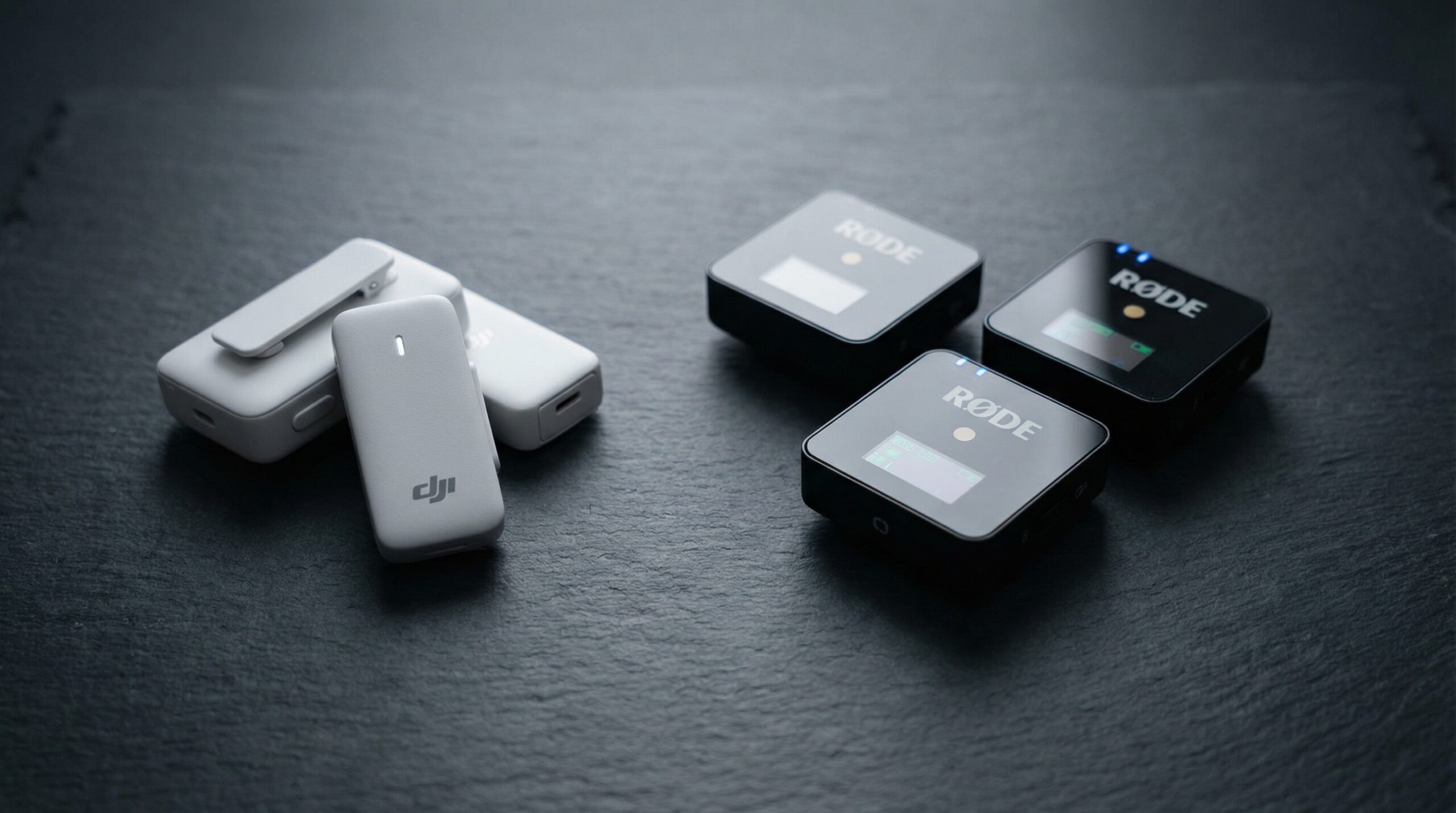

Last week, I was on a shoot where the director asked me to compare wireless mic systems. “Just tell me which one to buy,” she said. “I don’t care about the technical stuff.”
I told her: “They both work. It depends on your workflow.”
That’s not the answer she wanted, but it’s the honest one. After six months of running both the DJI Mic 3 and the Rode Wireless GO II across documentary assignments, I have enough data to give you a more complete answer. Here’s what I’ve learned.
System Overview
DJI Mic 3
The DJI Mic 3 is DJI’s third-generation wireless microphone system. Each unit consists of a compact transmitter (with built-in microphone), a receiver, and a charging case that stores and charges both units. The system records 32-bit float audio internally on the transmitter — meaning you can recover from clips where your gain was set incorrectly after the fact, a genuine breakthrough for solo operators who can’t monitor audio continuously.
Battery life with the charging case: approximately 18 hours total. The system operates on 2.4GHz with up to 250m range in optimal conditions.
Rode Wireless GO II
The Rode Wireless GO II is the second generation of what became the defining product category for compact wireless audio in 2019. The system uses two separate transmitters and a single receiver, both with built-in microphones. Each transmitter can record internally to onboard memory — a safety backup if your camera input fails.
Battery life per charge: approximately 7 hours. The form factor is smaller than the DJI Mic 3.
Audio Quality
Both systems deliver audio quality that is genuinely professional — broadcast-ready with proper gain staging and monitoring. The difference in audio quality between the two in normal conditions is not perceptible in a blind test.
Where they differ: the DJI Mic 3’s 32-bit float internal recording is a genuine advantage in challenging conditions. I have personally recovered usable audio from takes where I had the receiver gain set two full stops too low. With 32-bit float, those takes were clean after normalization in post.
“The 32-bit float on the DJI Mic 3 is the thing I didn’t know I needed until I needed it. I was shooting an interview in a jeep — the subject was unpredictable, the ambient noise varied constantly, and I couldn’t monitor continuously because I was driving. Three takes were unusable in fixed-gain. All three were recoverable from the 32-bit float files. That feature alone sold me.”
— Carlos Mendez, camera operator and documentary shooter, Mexico City
Battery Life: The DJI Mic 3’s Clear Advantage
The DJI Mic 3’s charging case delivers approximately 18 hours of total battery life. The Rode Wireless GO II delivers approximately 7 hours per transmitter/receiver pair.
On a typical documentary shoot day — 8-10 hours of active shooting — the DJI Mic 3 needs one charge cycle at most. The Rode Wireless GO II will need two to three. For solo operators who don’t want to think about battery management, the DJI Mic 3 is the clear winner.
Comparison Table
| Feature | DJI Mic 3 | Rode Wireless GO II |
|---|---|---|
| Price (dual TX) | ~$279 | ~$279 |
| Internal recording | 32-bit float | 24-bit fixed |
| Battery life (total) | 18 hours | ~7 hours |
| Range | 250m LOS | 200m LOS |
| Transmitter size | Larger | Smaller |
| Interface | Touchscreen receiver | Physical buttons |
| Charging case | Included | Separate purchase |
Range and RF Reliability
Both systems run on 2.4GHz — a crowded spectrum shared with WiFi routers, Bluetooth devices, and cordless phones. Both have frequency-hopping intelligence, but in my experience, Rode’s implementation has been slightly more robust in dense RF environments. Urban centers, busy hospitals, locations with significant WiFi congestion — the Rode tends to hold signal more cleanly in these situations.
That said, both systems performed reliably in 95% of my shooting scenarios. The RF gap is marginal and most users will never encounter it.
Where I Land
For solo shooters: DJI Mic 3. The extended battery life and 32-bit float recording provide safety nets that matter when you’re working alone. The convenience of the charging case alone is worth the identical price point.
For multi-camera setups and crews: Wireless GO II. The smaller form factor, slightly more robust RF performance in congested environments, and five-year professional track record make it the safer professional choice when you have someone monitoring audio continuously.
“My rule of thumb? If I’m not sure which to buy, I buy the one my collaborators already use. Compatibility matters more than specs in professional environments.”
— Documentary sound mixer, speaking off the record
The Bottom Line
Both systems cost the same. Both deliver professional audio quality. Neither is the wrong choice. The DJI Mic 3 is the better solo operator system. The Rode Wireless GO II is the better crew system. If I could only have one, I’d take the DJI Mic 3 for the 32-bit float alone.

Mehedi Rahman is a freelance multimedia producer and impact filmmaker with 12+ years of experience. He has shot documentary and humanitarian work across Yemen, Bangladesh, and South Asia for the World Food Programme and international media. Based in Sri Lanka, he specialises in visual storytelling that moves people — and gear that makes it possible.